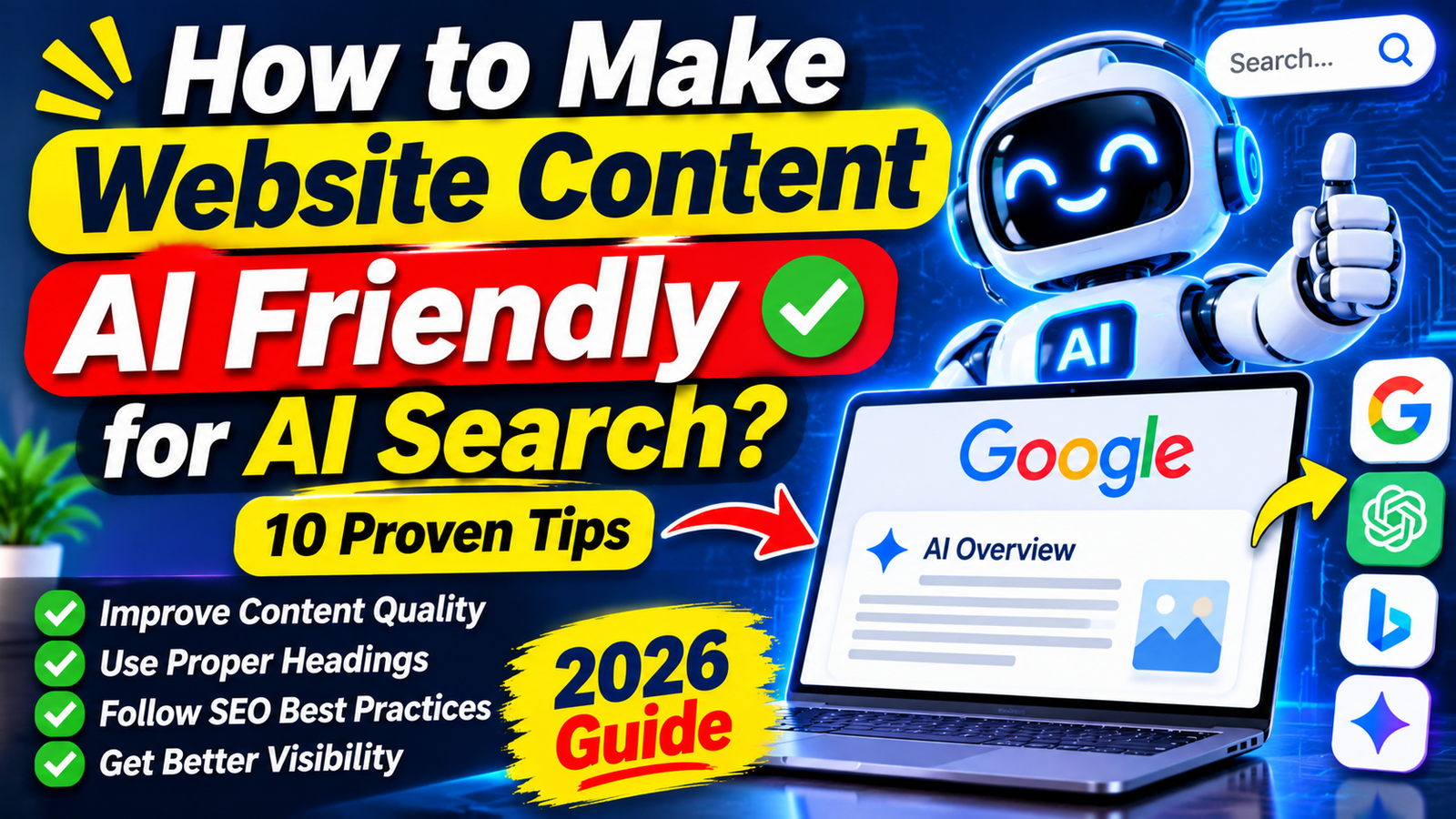
With search engines constantly evolving, website owners used to rely heavily on keywords, backlinks and traditional SEO techniques to rank pages in Google. However, with AI becoming more apparent, website owners can now take advantage of this change.
AI powered platforms like Google AI Overviews, ChatGPT Search, Microsoft Copilot and Perplexity can understand queries, search and create answers from relevant sources on the web.
This means website owners can create content that is easier for AI search engines to understand, search and reference.
But how can you make your website content AI friendly? Do you need specific keywords, tools or even a complete overhaul of your SEO strategy?
Let’s look at some practical ways to help make your website more visible for AI powered searches.
Provide Clear Answers
One of the most important things you can do to make your website content more AI friendly is to provide clear answers.
AI needs to understand what your page is about and what questions it can answer.
Instead of having lots of lengthy introductory text about smartphone batteries, explain clearly why your phone battery is draining quickly.
Best practise:
– Provide a clear answer to the main question early in the article.
– Keep your language simple and easy to understand.
– Keep paragraphs short and don’t include unnecessary introductory text.
– Define any technical terms.
– Keep paragraphs to one point.
This makes your content clear to read and the key information stands out.
Use Relevant Headings
An organised piece of content will be much easier to understand for your audience and search engines.
Start with one clear H1 heading, then include relevant H2 and H3 headings.
If you’re writing about website security you could have headings like:
– What Is Website Security?
– Why Is Website Security important?
– Common website security issues
– How to secure your website
Don’t use headings to add extra keywords, each one should provide useful information.
Create Original, Useful Content
Original content is extremely important for modern SEO and AI search.
Copying other articles doesn’t provide much extra value. AI search engines can pull information from many sources so adding another generic article won’t really encourage people to visit your website.
Include:
– Real examples
– Original research
– Personal experience
– Detailed comparisons
– Useful insights
– Problem solving information
If you’re writing about Android battery problems include real reasons why the battery is draining, safe fixes and explain the difference between typical battery behaviour and hardware issues.
Google’s 2026 guidelines suggest focusing on providing high value unique content that isn’t generic.
Answer Real Questions
More and more people are asking questions when searching through AI platforms.
Instead of searching for ‘website speed,’, someone might search How can I make my website load faster on mobile?
Make sure your content is answering real questions.
You can do this by looking at:
– Google Search Console
– Google’s suggested searches
– People Also Ask
– Customer feedback
– Relevant conversations online
Add useful sections to answer related questions. Don’t create dozens of similar articles to target different keywords.
Use Credible Information
AI search engines need to be able to understand and verify information.
Whenever you include statistics, technical information, product details or any key information, make sure it can be backed up with credible information.
If you’re writing about website security use official documents from recognised security organisations or technology providers.
Also ensure:
– Any relevant dates are included.
– Out of date information is updated.
– Key statistics are noted with their source.
– Any incorrect information is corrected.
– No unbacked claims are made.
This makes your website more useful.
Optimise Technical SEO
Even if you’ve created some amazing content, if search engines can’t crawl your website properly then your content won’t perform well.
Ensure:
Robots.txt – Important content isn’t blocked accidentally.
XML Sitemap – Your sitemap is up to date with your key canonical URLs.
Internal Links – Related articles are linked with descriptive links.
Mobile Friendly – Website works well on smartphones and tablets.
Page Speed – Minimise unnecessary scripts, large images etc.
Indexed – Check important pages are being indexed using Google Search Console.
Google confirms traditional technical SEO fundamentals are still key.
Use Structured Data Correctly
Structured data helps search engines understand specific information on your page.
This could be using Schema.org to define what type of article, product, organisation etc you have.
Common structured data types include:
Article
Product
Organisation
BreadcrumbList
LocalBusiness
However, the information needs to be accurate to what is seen on the page.
Just adding schema won’t guarantee your content will be picked up or referenced by AI platforms. Google also confirm there isn’t any special AI schema required to be shown in AI Overviews or AI Mode.
Keep Content Up to Date
Out of date content can make your article less useful. If people are searching for the latest technology, software, pricing or product details then they won’t get the most up to date information.
Regularly check your key pages and update:
Out of date stats
Broken links
Out of date screenshots
Software guides
Product information
Incorrect technical information
Only update dates if there has been a meaningful change.
Keep Website Easy to Understand
A great website will make it easy for people to find the information they need.
Use descriptive page titles, meaningful menus, easy to read fonts and logical links.
Use descriptive alt text for images and useful titles for videos.
Don’t hide important information in images when it can be displayed in text.
Also ensure ads and pop ups aren’t stopping people from seeing the main content.
Check How Well Your Website Is Performing in AI Search
Once you’ve created AI friendly content you should also check how well your website is performing.
Using Google Search Console will help you understand how your website is performing in search, being indexed and any technical issues.
Microsoft Bing Webmaster Tools now includes an AI Performance section which shows how your website pages are being referenced in supported AI generated answers like Microsoft Copilot.
Look at this information to see which pages are being referenced. This will help you to identify any areas that could be covered better.
Keep in mind this is measuring how well your content is being referenced in AI. This doesn’t mean people are clicking through to your website.
FAQs
What is AI friendly content is clear, accurate, organised and useful information that AI search engines can understand and search.
Do I need special SEO techniques?
No. Traditional SEO fundamentals, original content, technical SEO and useful information are key.
Does Google require an llms.txt file?
No. Google doesn’t require an llms.txt file or any special AI marking up.
Can AI generated articles appear in AI search?
Yes. However the content needs to provide real value and follow search guidelines. Don’t create generic pages to try and boost rankings.
How can I check if my website appears in AI search?
Use Google Search Console to check how your website is performing in search. Use the AI Performance section in Bing Webmaster Tools to see how your content is being referenced.
Final Thoughts
Creating content that is easy for AI search engines to use isn’t about using hidden keywords. It’s about creating original, accurate, organised and useful information.
Focus on answering real questions, providing back up for any key facts, ensuring technical SEO is optimised and regularly improving your articles.
As AI powered search continues to develop, websites that provide meaningful information and a useful experience will be more likely to gain visibility. Whilst there is no guaranteed way to get referenced in AI, creating a credible and informative website will be a good long term strategy.